Showing posts with label German beer. Show all posts

May 11, 2012

Reinheitsgebot 1516 - The German Purity Law from 1516

In this post I will not talk about a beer in specific, but about a law. With this, I intend to bring some light upon a myth about beers which are produced nowadays "accordingly to the german purity law from 1516".

For that, I will start pointing a few reasons why this law was created; a little about its history; and the consequences of its implementation in whole Germany.

The formulation of this law has some noble objectives, as for instance, to regulate the beer commerce in all the cities of Bavaria, defining the volume of a Maß (1,069 Liters), its price and rules for exporting. But at the same time, the law stablished production and commerce limitations that would favor a monopoly of bavarian brewers against brewers from other regions, for example, from the region today known as Belgium.
A Maß - 1,069 liters of beer
The law was stablished first individually in each city, following their particular needs. For instance, Friedrich Barbossa, in the city of Augsburg, 1156, stablished a punishment for whoever would sell/serve 'bad' beer or charge irregularly for it. In 1348, the city of Weimar added 'hops', until then not allowed, to their list of beer ingredients.

The hunger crisis in Nuremberg (1393), made the regents of that city define that only barley should be used for beer, while the other grains (rice, wheat, rye...) should be solely used for feeding the starving population. In 1487, Duke Albrecht IV implemented a series of standards for beer quality control in Munich.

After the Landshut war of succession and the re-unification of Bavaria, there was also the need of unifying all the scattered beer regulations along the Duchy. So on April the 23rd, 1516, the Bavarian Purity Law was implemented by Duke Wilhelm IV and Ludwig X, in the city of Ingolstadt. The law stated that beer should contain only barley, hops and water. Hops were chosen for acting as natural beer conservatives. Some disastrous attempts to use other ingredients as conservatives (including wild mushroomns) also helped bringing the restriction upon the ingredients.

     
Hops, barley and water, the only three ingredients allowed by the original law

Finally, in 1871, during the German unification, Bavaria imposed the application of the Reinheitsgebot as a condition for them to join the new forming country. This act and the acceptance of such conditions, caused the northern german spiced beer tradition to disappear, only a few northern traditional beerstyles survived, such as the Düsseldorfer Altbier and the Cologner Kölsch.

Bayrisches Reinheitsgebot (1516)
A lot has been discussed over the years about the restrictions, and the law was modified a few times after that, in a way to adaptate to modern times discoveries, such as the fermentation process and the consequent addition of yeast tablets to beer. The beer regulating law that vigors in Germany today dates from 1993, and is a lot more flexible than the old one.

Today, some breweries still claim to abide to the old 1516 law, even though they use malted rice, malted wheat, yeast and fining agents in their beers. Don't let yourself be fooled by such marketing maneuvers.

Also, a beer does not need to follow the Bayrisches 1516 Reinheitsgebot to taste good... if you doubt this, then you should try some belgian/french spices containing monastery beer, some english ales, which contain sugar, or even taste the traditional bavarian Weissbier (which contains wheat malt and, therefore, does not abide to the 1516 purity law). Or maybe you should just read properly and more carefully the ingredients of your favorite beer.

   
        Belgian Strong Ale  -                  English Pale Ale  -                Bavarian Weissbier

The only thing you should use to pre-judge your beer is your country's food regulation agency approval.

Cheers for all the good beer!

Jan 4, 2012

Ayinger - Six Pack

This six-pack includes six different kinds of beer, from the left to the right: Albairisch Dunkel (Old bavarian dark), Ur-Weisse, Kellerbier (Cellar beer), Helles (Clear), Jahrhundertbier (Centenary beer) and Bräu-Weisse.

The Ayinger brewery is located some 25km south to Munich, Germany. It's an internationally awarded brewery, receiving gold and silver prizes almost every year for at least one of its beers.

Although its located very close to Munich, it's out of the city limits, and therefore cannot take part of the Oktoberfest. As several other good breweries located slightly out of the borders of Munich (such as Erdinger, Weihenstephaner and Kloster Andechs), Ayinger has to promote its own beer festivals along the year.

Those festivals are not so famous and touristy, and tend to conserve a good deal of the old traditional ways.

For this six pack I thank Tai Asano, who heard about my collection through his daughter and made a valuable contribution towards its expansion.

Link to the producer: http://www.ayinger.de/?pid=262

Nov 18, 2010

Lenin's Hanf - Aromatic Helles


Lenin's Hanf in german means "Lenin's hemp". The beer is named after one of the (if not the only) owner of Neustädter Hausbrauerei, but it also brings to the mind the name of the former Soviet dictator. That should make a lot of sense when I tell you that this beer is produced in Dresden, German city that was on the East side of the Iron Curtain untill the reunification.

Produced by a small home brewery, this beer contains Hemp flowers as aromatics. The flowers give a slightly sweet taste to this 5,2% helles beer. As you can see in the pictures, the only label is a small printed and clipped piece of paper that comes around the bottles neck.

I don't usually make comparisons in this blog, but the other hemp beer already posted wasn't as half as good as this one... and this is probably one of the very rare beers in my collection, once the production and distribution is quite restricted! But it was not that easy to aquire...

A fellow collector (Andreas) and I were visiting a friend (Lorenzo), in Dresden, when we came accross this beer in a club at the city center. As usual in clubs, you are not allowed to leave the place carrying glasses or bottles, and I was already planning how to hide it under my jacket when Andreas told me something like "It's allright, I talked to the waitress, we can take the bottles".

The only problem is that the bouncers didn't believe Andreas as I did, and it took us some time to get the waitress to come and explain the whole ordeal... in the end, we had to leave the bar with the bottles under the jacket anyways... next time, we do it my way!! ;)

Link to the producer: http://www.obergaerig.de/seite2_hausgebraute_biere_aus_der_neustadt.html

Nov 5, 2010

Lammsbräu - Urstoff


If there is a "Lions brewery" (Löwenbräu), why not a "Lambs brewery"?

This brewery, localized in the city of Neumarket, inner Bavaria, produces only beers with the European 'Bio' certificate and, therefore, call themselves "Ökologisches Brauerei" (Ecological brewery in german).

Their Urstoff is 4,7% alcohol and comes embottled in 500ml glasses. Due to the proximity of Neumarket to Altötting, I end up asking myself if this beer was a gift from Anderl or not... according to my notes, it is not, so maybe I bought it there, or maybe my notes are wrong...

No, drinking beer doesn't cause memory problems, at least, not that I remember...

Link to the producer: http://www.lammsbraeu.de/index.php?id=31

Oct 27, 2010

Hardcore - Pilsen


Got this beer as a gift from Andreas (and I wonder how many more times I am going to write this here...) when visiting him in Altötting in the autumm of 2010.

The label is very elaborated, but it is mostly a regular beer. Produced in Germany and embottled in a 330ml bottle, this pilsner beer contains 4,9% alcohol...

The day I wrote this post I was interrupted by a terrible headache... up to that point my tries to find the brewery's name had been not very successfull (try typing 'hardcore' or 'hardcore beer' or even 'hardcore brewery' in google and see what you get...) so I promised to do it later...

Before I could keep my promise and finish the post, Boize posted the link in the comentaries... thank you!

Link to the producer: http://www.sle.de/cms/SLE/index.php?idcatside=173

Hacklberg - Jubiläumsbier


The Jubiläumsbier was produced as a limited edition to celebrate the 375th anniversary of Hacklberg, a brewery located in the city of Passau, Germany.

This 500ml bottle was aquired while visiting a friend in Altötting, inner Bavaria, thanks to his tips about a local getränkemarkt. There I could find, among others, this 5,5% alcohol special edition of Hacklberg.

I must state here that Andreas also provided the transportation to the place, otherwise I wouldn't be able to carry that many beers at once, or maybe I would... I've done this before when moving back from Augsburg... oh well, it is more confortable to carry the bottle in a car, and the liquid in your stomach... thanks again Anderl!

Link to the producer: http://www.hacklberg.de/main_jubilaeum.html

Oct 25, 2010

Unertl Weisse and Dintel Weisse


This two beers are occuping the same post for 3 reasons:
1. They are from the same producer;
2. They are (roughtly) the same type of beer;
3. They were both a gift from Andreas Pelzberger, Bavarian friend and great colaborator of my collection.

Both have the same 500 ml, but there are a few differences. The Dintel weiss is a little bit stronger (5,2% instead of 5,0%) and it's produced with a different kind of wheat, the Dintel grain, which is more difficult to handle and therefore more expensive to use.

It is not common to find weissbier produced with this kind of wheat, but your chances will be slightly higher if you search in regions like Bavaria, where weissbier is considered essential part of people's nutrition, been consumed regularly by businessmen during lunch break or even in the family traditional breakfast (weisswurstfrühstuck).

Link to the producer: http://www.brauerei-unertl.de/products_en.htm

Oct 13, 2010

Löwenbräu - Original


Also one of the first bottles I kept in my shelf, and also another traditional Bavarian beer. The word "Original" stands for original Münchner beer.

The name of the brand (Löwenbräu) means "Lion's brewery". The lion on the label can be also seen at the TSV 1860 jersey; that's why this football team, sponsored by Löwenbräu, is also known as "die Löwen" (the lions). If you don't know the team and have the curiosity, here's the link: http://www.tsv1860.de/

TSV 1860 plays for Bundesliga's second division, if they can't be the best, they are at least sponsored by a 1st class german beer.

Link to the producer: http://www.loewenbraeu.de/de-de/loewenfuetterung/loewenbraeu-original.html

Oct 7, 2010

Cannabia


I must say that this one is really curious. After tasting beers with bananas, honey, manioc, matte, cherries and a lot of other weird things, this one called my attention, kind of hidden on a shelf in a supermarket at München Hauptbahnhof.

Yes, it is a 330ml bottle of a 4,8% alcohol containing beer brewed with Cannabis, and with the european Bio certificate! It's a German product, I also found other drinks, like Lipton Ice Tea, with Cannabis, but got only the beer.

I hate to disappoint the readers, but drinking one of this gives you the effects are of a normal beer (none), and I can't really compare the taste, once I have never (and don't really want to) smoked this herb.

The only thing I hope is that the Bio certificate is true and the Cannabis is really grown here in Europe under government supervision, instead of being "imported" from South American countries, where the dealing of hemp and other drugs finances crime. Sorry for being lame about this subject, but this blog reflects my opinion.

This isn't a beer that will be inside my fridge regularly, but it was worth trying it.

Link to the producer: http://www.cannabia.com/

Oct 6, 2010

Spaten Optimator


This is a Doppel Bock beer, produced by Spaten, another traditional bavarian brewery. This bottle of Optimator contains 330ml of 7,8% alcohol Starkbier (that one, produced for Starkbierfest, in May, remember?)

No, Munich doesn't have yet too many breweries, there's always one less famous, more hidden or smaller but never less tasty. This one is a quite big brewery though, and shows in its symbol two shovels, or 'zwei Spaten' in german.

Link to the producer: http://www.hofbraeuhaus.de/en/index_en.html

Hofbräu Original Münchner*


With the end of the Oktoberfest 2010, I bring to you this 500ml bottle of the Original Münchner beer (5,1% alcohol) produced by one of the most (if not the most) traditional breweries of Munich.

Hofbräuhaus, also know by the short way HB, is one of the touristic points in Munich, and though their website doesn't show the products, it contains some funny stories and curiosities... it's worth checking.

Link to the producer: http://www.hofbraeuhaus.de/en/index_en.html

Oct 1, 2010

Löwenbräu - Triumphator


This is a 500ml bottle of the Double Bock produced by Löwenbräu, one of the biggest breweries in Munich, Germany. It is, as stated before, a seasonal beer, produced for the Starkbierfest, that happens every march/april.

It contains 7,6% alcohol, that's why is called Starkbier (Strong beer, in german). This kind of beer was originally produced by monks during the period of reflection and fast that preceeds Easter, it's meant to be very strong and nutritious, so it could feed the monks during the period they were not alowed to eat (but still allowed to drink).

Link to the producer:  http://www.loewenbraeu.de/de-de/loewenfuetterung/loewenbraeu-triumphator.html

Sep 29, 2010

Celtic


Don't mistake this one for the italian beer"Celtica" posted before! This beer is produced by Thorbräu, a brewery located in Augsburg, Germany. The 330ml bottle was bought in a Getränkemarkt near the place I used to live there.

It contains 5,0% alcohol and attends to the European Union standart for 'Bio' products.

A curiosity: when I live in a place, I end up not knowing the touristical places as if I was there for only two days, mostly because of that old idea: "I can go there anytime, I am living here!"

Well, that stupid idea brought me to the following situation: last day in Augsburg, all the stuff I should bring to Munich inside a backpack or somehow attached to my bike, which I was supposed to ride untill the central station for the train (about 4km, not that far) and I STILL HAVEN'T STOPPED AT THE GETRÄNKEMARKT TO BUY ALL THE BEER I WANTED TO!! In the end, I had to somehow add to all the stuff I was already carrying a bunch of bottles still full (including this one).

I would never forgive myself for missing the opportunity, maybe I'll still pay Augsburg a visit and get some more of their local beer...

Link to the producer: http://www.thorbraeu.de/content/brauerei/augsburg/home.html

Sep 23, 2010

Schorschbock - Bock


Bought in the same package and with the same oil-like aspect as the Schorschweinzen, posted just below.

The difference between them is that this one is Lager-type (in this case, bock), but this reflects more in the lable, once both beers have such a strong alcohol taste that is hard to distinguish anything else.

Besides the taste, has the same 330ml, 16% alcohol and is produced by the same frankonian brewery.

Also the same observations apply, attracts me as a curiosity, not as a beer.

Link to the producer: http://www.schorschbraeu.de/schorschbraeu/site/

Schorschweizen - Weissen Bock


There is brewing beer for the taste of it, and there is brewing beer as a challenge, this Frankonian brewery decided to go for the challenge. Producing the strongest beers ever produced through natural fermentation, Schorschbräu is always featuring on world records books. It produces very exclusive beers, in a very limited number due to the time taken in the fermentation.

This 330ml bottle, found at a market in München Hauptbahnhof, is the strongest weissbier (actually, a weissenbock) in the world produced according to the german law purity, it has 16% alcohol and a very dark and thick aspect, according to some friends: "Hey, this looks like oil!"

Some people might appreciate the taste, the challenge of drinking a 16% beer, I enjoy solely the exclusivity of the bottles, because in my opinion, it just doesn't taste like beer anymore.

Link to the producer: http://www.schorschbraeu.de/schorschbraeu/site/

Sep 22, 2010

Schneider Weisse - Aventinus*


Schneider Aventinus, or Tap 6, is a weiss doppelbock beer, one of my favorite types of beer, it's a seasonal type, produced in march for the Bavarian festival 'Starkbierfest'.

This is a 500ml bottle of one of the most awarded starkbiers (check the link below to see the prizes), with 8,2% alcohol, this is one of the beers that everyone should try.

Link to the producer: http://www.schneider-weisse.de/index.php?lang=en&tpl=brauerei.spezialitaeten.aven&sid=80827660306872728240576670860808

Sep 15, 2010

Wersteiner Premium Verum


The Wersteiner is an international beer, originally produced in Germany, but also in several other countries. This 330ml bottle, for instance, was produced in Argentina, and, although it has the same 4,8% alcohol pilsen beer inside, the taste will never be the same as the one produced in Germany.

There are also other kinds of Warsteiner, they promote the mixing of beer with cola, orange juice and other stuff. You will never see any of these other bottles in this Blog.

Link to the producer: http://www.warsteiner.de/html/Unser_Bier_Premium_Verum.html

Das gute Zirndorfer Landbier


Translating, it sounds something like "the good 'country beer' from Zinville" but one should not translate the name that identifies a beer nor its brand- this is a 500ml bottle of Landbier, one of the traditional kinds of beer Bavaria has to offer to mankind, produced by Zirndorfer, contains 5,0% alcohol.

Link to the producer: http://www.zirndorfer.de/

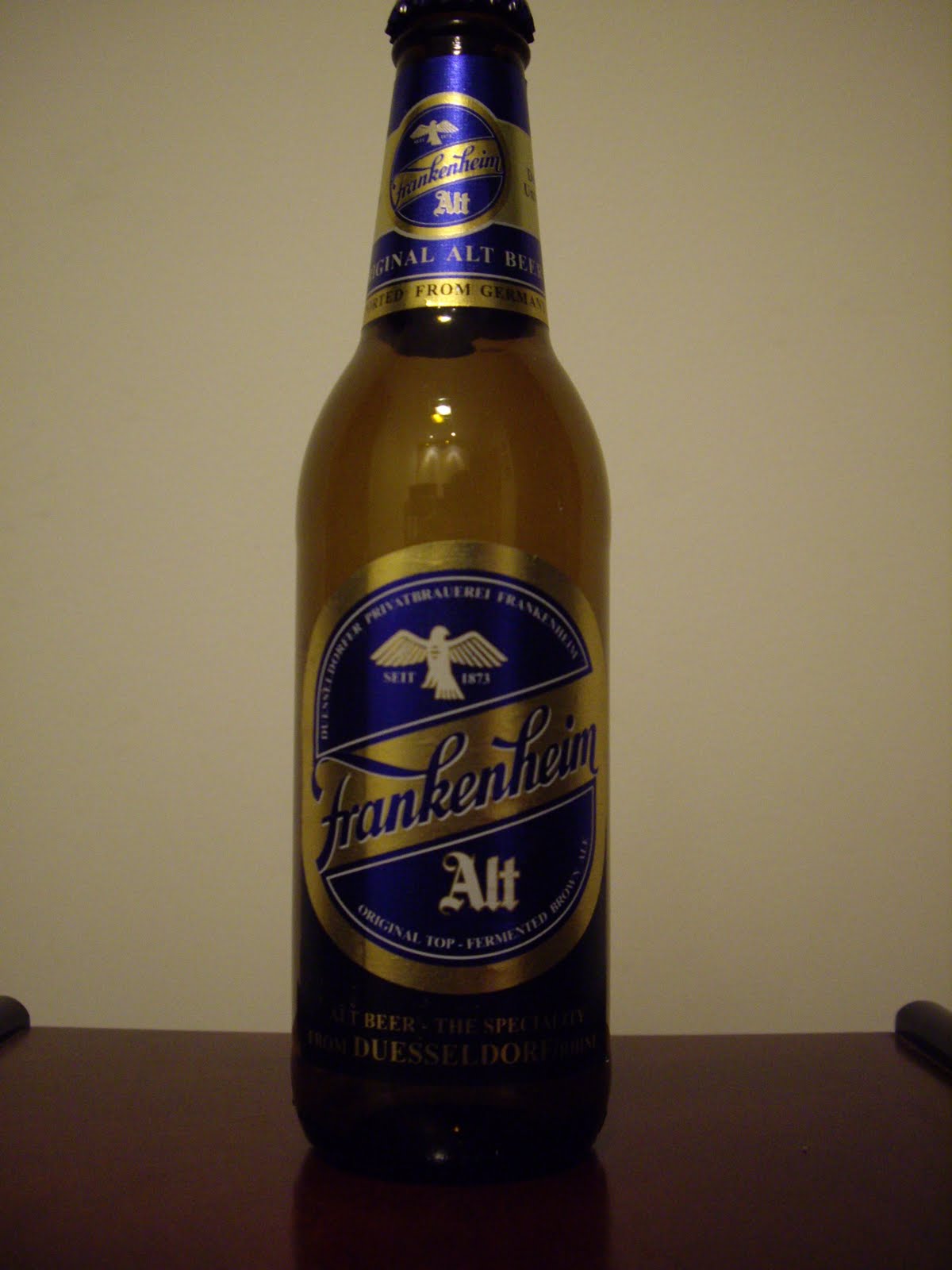
Frankeinheim Alt


Frankeinheim is an Altbier, this quality of beer is only produced in Düsseldorf, city located in North-Westphalia, Germany. Frankenheim is one of the most common examples of Altbier, with 4,8% alcohol, comes embottled in different volumes, this bottle is a 330ml.

Link to the producer: http://www.frankenheim.de/index.php?option=com_content&view=article&id=53&Itemid=65

Sep 14, 2010

Schneider Weisse - Original

This is one of the most beautiful and unique bottles in my collection, bought in a supermarket in Brazil.

I am still trying to find this fine, 330ml, blue bottle here in Bavaria, Germany, where it is produced, but all I can find is the regular brown 500ml bottle (that will be posted in another ocasion), which contain more of the same 5,4%, good-tasting weissbier inside, but does not look so nice empty in a shelf as the first one.

Here's the link for the producer: http://www.schneider-weisse.de/