Aug 8, 2016

Jacquie & Michel - A beer with a suspicious label


Dear beer enthusiasts,

It has been a while since my last post... and I have no excuse for that, I have many beer-related stories to post, waiting on a small post-it wall behind my door!! For that, I sincerely apologize.

But sometimes all you need to trigger your creativity and kick you back into posting again is a really good beer or a really unusual and random story. This post was triggered by the second one...

This story starts with a couple of friends visiting the Loire Valley, in France. As usual, my american friend Susan and her French husband Christophe went the extra mile to get me some regional brews. They ransacked beer sections of unaware supermarkets on their way, bravely resisting the will to get Belgian ales and wisely ignoring all mass produced French brands (like Kronenbourg), keeping the sole focus on finding beers that would definitely be new to my collection.

On their rampage, Susan found the following 330ml bottle of a 5.2% alcohol lager beer, under the name of Jacquie & Michel... the label states that this beer was produced specially for the SARL Beer Market, but is a bit suspicious, as it says nothing about the brewery which actually did it

Jacquie and Michel - Find all the clues in the label, your suspicions might be right!

The label brings yet another suspicious statement in French. With my limited ability in that language, I could get something like: "a blond beer which is docile at first but has a strong character, and that it pays tribute to the fans who help to maintain the myth alive"

The translation was confirmed by Christophe, once Susan's French is also a bit limited, but he swears he was not aware of the purchase of this specific beer... Susan confirmed it.

The amount of X's in the logo, together with the lipstick kiss mark under the name of the beer made all of us even more suspicious about the nature of the above mentioned "myth" and its supportive fans. A quick check on the website indicated on the back of the bottle and Voilá! Our suspicions were confirmed.

This is a beer specially made for the fans of an, apparently, famous French porn website.

I say "apparently" because Christophe seemed honest enough when he said he never heard of that site before, and I suspect he would have no reasons to lie about that (call me naive if you will...)

I erased the addresses from the label because I am not here to promote porn sites... The only thing I could promote is the beer, but I have to say that it was actually not a very good beer (I'm trying to be positive here!) just the smell of it reminded me of the mass brews you can find in the US and Brazil, filled up with non-malted cereals (namely corn and rice) to make it cheaper.

I am not 100% sure that this beer contains corn and rice, but the fact that the only thing stated on the ingredients is "contains barley malt", makes me incredibly suspicious that I might be right, once it doesn't necessarily denies my initial assumption. Also, as I learned when I ended up inadvertently visiting a French porn website, my suspicions are not always fruit of pure paranoia or of my nasty, dirty mind.

Thank you, Christophe and Susan, for yet another interesting story for my blog, I promise that all the other 8 bottles you brought me (all much better in taste that this one, I must say) will also get their recognition :)

Cheers!

Apr 24, 2016

500 years of Reinheitsgebot

Dear beer enthusiasts,

on the 23rd of April of 1516 the Reinheitsgebot was signed in the city of Ingolstadt, a few kilometers north of Munich. That happened roughly 10 years after the end of the Landshut war of succession, during which, Bavaria was divided in two factions,

That law summarized the previous regulations created individually in many cities throughout the duchy of Bavaria. And nothing better to help unify Bavaria than making official through the whole duchy a law that protects the purity of beer!

Representation of a text extract of the 1516 Reinheitsgebot

Yes! Previous to the purity law, many have attempted brewing with different, odd ingredients, some adding potentially dangerous herbs and even mushrooms to their beer. So the purity law stated clearly that, from that day on, only barley, water and hops should be used to produce beer. Any conscious attempt to use different ingredients, would result in the confiscation of the barrels produced.


But why limiting the used of malted grains to only barley? Nowadays, many breweries around the world use cheaper malts (for instance, rice malt) to bring their costs down, and that represents a big drop in quality for the consumer... but that was not the reason back in 1516. At that time, it was important for the cities to stock on wheat, rice and rye. Those grains should be used to feed the population and avoid famines like the one in Nuremberg in 1393, and not to produce beer.

Also, the 1516 Reinheitsgebot regulated the volume of a "Maß" (1,069 liters) and the price to which it should be sold depending on the type of beer and season of the year.

So, it is pretty clear that the law made sense at that time... but does it sill make sense 500 years later?

To answer that, we have to take into consideration that many things have changed in 500 years, economically and technologically speaking. Here are just three examples that should leave no doubt about that:

1 - Fermentation was discovered.


That means yeast had to be included in the list of allowed ingredients, because that is a lot more hygienic than adding old beer to the brewing process for "good luck"! (YES! That is what old time brewers used to do back when people had no idea about how the fermentation really worked)


2 - Agriculture technologies and logistics advanced quite a lot since the 1500's


There is no need to limit the use of grains to only barley. Wheat and rye can be easily used to produce beer without risking a local famine or a global shortage of bread.


3 - Economics and capitalism.


Feudalism is over, and most states no longer regulate the price of beer, prices are now determined by the global and local markets. That part seems to be very well understood by breweries nowadays, even those who claim to abide to the 1516 Reinheitsgebot.


As the times changed, the laws also changed, that's what we call progress. Nowadays, many legally produced types of beer don't follow the old 1516 regulation anymore... care for some examples?

Milk stouts, for instance, have milk sugars (lactose) in their composition, which help achieving the high fermentation needed to produce this very exquisite type of beer.

English Milk Stout
Many Belgian Ales have herbs and spices in their recipe, which give the beers their unique taste, and brought Belgium the fame of one of the best beer-producing countries in the world

World famous Belgian ales

Last but not least, weissbiers contain wheat malt, and are among the most traditional beer types. Schneider & Sohn produces solely weissbiers (and very good ones), they are a very traditional and respected brewery and are ironically located about 30 km away from Ingolstadt, where the law that prohibited the use of wheat malt was signed!

Schneider & Sohn - Producing Weissbiers only!

It is quite clear that, today, a beer does not need to follow the 1516  Bavarian Reinheitsgebot to be tasty.

The breweries that claim to follow that old rule do this mostly for marketing purposes... after all, no modern brewery wants to have their prices dictated by the state, and if you ever visited Oktoberfest in Munich, you know that what they call a "Maß" is poorly drafted and barely amounts to 1 liter, much less the 1,069 l determined by the 1516 law

Nevertheless, despite of all my argumentation about how this law doesn't make sense anymore in modern times, the 500th anniversary of the Bavarian Reinheitsgebot is still a date to be celebrated. It's undeniable that the enforcement of such a law did make sense back then, protected the consumer and helped popularizing beer even more.

There were some other, not so nice, consequences of the enforcement of this law, which I mention in a previous post, but you can't really blame those who created the law for that.

For all that it matters, the 1516 Reinheitsgebot was created with the noble goal of ensuring the production of good beer! Therefore, its 500th anniversary should be celebrated with a glass of good beer!

It doesn't matter if you do it with a tall glass of Weissbier, a pint of stout, a 500 ml bottle of Roggenbier (rye based beer) or a Maß Helles produced accordingly to the old law.

To the 1516 Reinheitsgebot, and to all good beers!

Prost!

Mar 6, 2016

Cruzcampo - (not so) Sponsored content


Dear beer enthusiasts,

no, Cruzcampo is not paying me to write this... unfortunately I'm not quite there yet :P

While many news websites take in donations in exchange for writing articles which are dubious and might mischievously lead the public to buy a product or somehow benefit the sponsor, this blog takes a much simpler approach on sponsored content.

It works like this: You bring me a beer bottle (full, please) that I don't have in my collection, and you get a post here. The post will, in all manners, reflect my honest opinion, "sponsored" or not... pretty simple and straight forward stuff, no hidden intentions :)

That being said, let's get started!

Cruzcampo is one of the most sold beers in Spain, founded in 1904, the brand used to belong to the Guiness group (which acquired it in 1991) but since the year 2000, belongs to the giant Heineken conglomerate. Its brewery is still located in the region of Sevilla, although it was moved from its original location inside of the city, and had its offices moved to the Spanish capital.

Cruzcampo - the "I can't believe you haven't got it yet" beer

This 330ml bottle filled with a 4,8% Pilsner is a common sight in that region, nevertheless, I had personally never had the opportunity to acquire one of them, until I met Ana Conde Ramirez, from Sevilla. In a brief conversation about beers (my favorite subject) she mentioned her hometown beer. She seemed very amused by the fact that I didn't have it yet but also slightly offended by the fact that other non-sevillian Spanish brands - like San Miguel and Estrella Damm- were already known to me.

She promptly took action, and when Victor - her boyfriend - came to visit, he brought along a bottle of their red labeled local brew.

You might have noticed the man in red attire holding a beer mug in the label, that would be Gambrinus, the official Cruzcampo mascot (and unofficial patron of beers). You can read a bit more about him in our last post and also by clicking here.

Cruzcampo
Gambrinus as Cruzcampos Mascot

While many breweries around the world pay homage to Gambrinus, Cruzcampo took it up a notch when it comes to the commercialization of the name... the old brewery installations in Seville host today the "Gambrinus school of hostelry", and you can find a big chain of restaurants all over Spain called "Cerveceria Gambrinus", which proudly serves the Cruzcampo beer.

Now, although Gambrinus has been Cruzcampos mascot since the brewery was founded in 1904, I wonder how many Cruzcampo customers know the story behind the name "Gambrinus", and how much profit has this names commercialization brought to Heineken...

But who am I to condemn branding and commercialization... here I am, writing "sponsored" content :)

Thank you again Ana and Victor for contributing to the growth of my collection

Cheers!

PS: at the moment of this posting, the Cruzcampo website was flagged by my browser as a malware source, I will therefore NOT post the link to the website here. I like to believe that Cruzcampo is a victim in this case, and will edit this post as soon as their website is cleared.

Jan 31, 2016

Gambrinus Premium - Cheers to miscommunication!

Dear beer enthusiasts,

if you are a long time follower, or have perused through the older posts in this blog, you might realize that I have already written a short post about this 500ml beer bottle. You might also notice that this is the third different label for the same Czech 5.0% lager beer (in the old post, I uploaded a picture with two versions of it).

Regardless of how good a beer can be, I usually don't keep two or more bottles of the same beer, unless there is a very good story behind it. Yet, it was while attempting NOT to get this bottle again, that I ended up "ordering" it... but more on that later...

In my old post, I failed to underline that this beer is produced by the same brewery of her more famous "sister", the Pilsner Urquell.  I also stated at that occasion, that Gambrinus was the unofficial patron saint of beer, which is part of the legend, but not really 100% correct. 

There are different theories about who had actually inspired the creation of the legendary entity of Gambrinus, some of these theories involve dukes, counts and/or kings of the Flanders and Brabant regions, some involve Germanic kings and others even ancient Egyptian gods.

One of these stories caught my attention. It links Gambrinus to John I, the duke of Brabant from 1267 to 1294. Johns dukedom included the city of Brussels, and was a wealthy beer-producing jurisdiction. He was, it is said, very loved, and became an honorary member of the local brewers guild. The name Gambrinus would have been a corruption of his Dutch name, Jan Primus. At that time, such things were bound to happen, after all, communications were limited and writing was a privilege of few.

Gambrinus - or would it be "Jan Primus"?

Apart from the miscommunication that generated the Gambrinus legend, fact is that several breweries pay homage to both the legendary entity - Gambrinus - and to the former duke of Brabant. The Hertog Jan Browerij is named after Jan Primus, Duke of Brabant, and the Spanish brewery Cruzcampo based its mascot on Gambrinus, opening several pubs around Spain with the name of the legendary King of beers.

Now, going back to how I ended up "ordering" this bottle... It is funny to see that, many centuries after Jan had his name slightly altered, miscommunications still happen! Even if we have cell phones capable of reaching any major city in the globe almost instantly, we still fail to communicate properly.

It is so that Kai Lei Peng, one of the regular contributors to my collection, was in a trip to Prague, and asked me what beer I wanted from there. I said that I could send her a huge list, but it would be easier if I told her the ones I already had so she could simply pick any new one she came across... She asked me for the list - at which point I understood that she wanted the list of the Czech bottles I already had.

Without confirming that vital piece of information, I sent her a list of more than 30 beers, all part of my collection already, and she set off to get all of them with the help of two other friends, Angelo and Lei... The confusion was only clear to me when I got a message from her saying that she "only" managed to find some 15 of the beers on the list...

I then apologized to her for the confusion, and for all the stress I might have caused by sending her such an extended "wish list". I also told her that I would never abuse someones generosity to the point of asking them to bring me over 30 bottles of beer in one trip. She then asked me to at least make the whole ordeal into a nice story for this blog...

So here it is, Kai Lei, this post is to thank you for this and all the other bottles you got for me in that trip to Prague and also in all other occasions... moreover, I'm keeping this bottle in the collection alongside the other two versions of it :)

Cheers

Jan 17, 2016

Schwechater Bier - To my anonymous contributers

Dear beer enthusiasts,

I have many people to thank for the diversity and size of my collection. Many good friends remember me when they see a new beer. They go through the trouble of packing full bottles in their luggage, carrying extra weight around in their backpacks during their trips or even bothering their friends and relatives to bring me some beer from their region.

While these good friends (it would be unfair to cite names here, I'd unavoidably leave someone out) have a special place in my heart, today's post is not about them...

This post is about all the strangers who, upon hearing about my collection for the first time, felt compelled to contribute with something, and effectively did it!

Although my mother told me many times not to get candy from strangers, when it comes to beer, I tend to trust the generosity of people, as you might already have realized when you read the San Miguel story at a jazz bar in Düsseldorf, ... besides, no one would try to kidnap a broken grown-ass bearded man...

Even better than in that jazz bar, this time, instead of a massively distributed Spanish beer, I got a much tastier brew from a local Austrian brewery in Schwechat, in the vicinities of Vienna.

Schwechater Bier - Accepting beer from strangers

Although this brewery has been standing there since 1632, it was only last time I visited my sister, for 2015-16 new years eve, that my brother-in-law made me aware of the existence of this 500ml bottle of 5.0% lager beer . Needless to say that I felt immeadiatly compelled to get one for the collection...

Once in the brewery's shop, I was made aware that I could not purchase individual bottles, only crates. Faced with indecision in between the two options available and with the inability to carry one crate of each back home, I told the store clerk the reasons behind my request for a mixed crate.

His first reaction was to make me repeat the number of bottles in my collection, so to be sure he heard it right. After that, and also after inquiring me "where the hell do you keep all of those?" he offered me a quite generous deal: 

- I can't sell you a mixed crate, but you gotta go back home with both of them, so I will just throw in an extra bottle to whichever crate you buy... call it a new years gift!

This small, kind gestures are priceless... gifting me a bottle of beer definitely doesn't bring the clerk anything, and it's just a small sacrifice from his side when compared to the value that a new bottle has to my collection

The fact is that he heard my story, judged it to be honest and true (and not only me trying to get things my way) and was happy to help as he could.

As of me, happy with the two newcomers (the other beer will feature a different post, in the future), I also told him about this blog, gave him the web address and told him he'd probably feature in a post.

To all my friends and strangers who contributed, your post will still come, I promisse :)

To the clerk who went the extra mile and threw in a free beer: Thank you! I can't remember your name, but I hope you read this!

Cheers!

Dec 20, 2015

Hollbeer Prestige - Beer with a "merry Christmas" touch

Dear beer enthusiasts,

As the end of the year approaches, celebrations start all over the globe. It can be of a religious nature -Christmas or Hanukkah- a national holiday -The birthday of the Japanese emperor, for instance- or merely the celebration that a new year is about to begin.

Even if you don't follow any religious tradition, neither is particularly aware that Mr. Akihito was born on December 23rd, you might still be surrounded by this festive mood... In most western countries, for instance, it is pretty much impossible to avoid the festivities.

Along with the celebration, come the special dishes, the cookies, the cakes and, of course, the seasonal brews!!

If you are in Europe, one of the best things to do in this time of the year is to visit the Christmas markets, and the French city of Strasbourg is rather famous for theirs.

It was December of 2010 when I, visiting Strasbourgs Christmas markets, came across this 500ml bottle of 7,0% Seasonal Christmas beer. It is product of a microbrewery called Brasserie du Vignoble, located in the city of Riquewihr, region of Alsace, France. The brewery doesn't really have a website, so this link should lead you to their facebook page,

Hollbeer Prestige - Honeybread beer

Although France is more known for its wine, and the village of Riquewihr is surrounded by many many vineyards, Alsace is also home to many microbreweries, which produce the most amazing beer.

This beer in particular has a taste that couldn't fit better with the season... Lebkuchen - a kind of Alsacian/German honeybread! It has a warming feel - due to the alcohol content - and a sweet background that brings cozy memories of past festive seasons.

While most breweries that try to somehow infuse a specific flavor in their brews usually end up going over the top, Brasserie du Vignoble managed to do it - in my most humble opinion - pretty much right!

They did it so right, that 5 years after drinking their beer, when I was thinking about the most adequated beer for a Christmas special post, Hollbeer Prestige, came immediately to my mind...

This year I was again in Alsace, but by bike, and couldn't get any beer. I gotta schedule another visit to Alsace, by car or by train (with an empty carry-on luggage...). After going to a wine fair to get kellerbier, I should step up a notch, and head to a wine country "just" for some seasonal brews

Happy holidays!

And cheers!

Dec 6, 2015

Köstritzer Kellerbier - Yes, Kellerbier!

Dear beer enthusiasts, 

you might be finding the title a bit odd, for either one of the following reasons:


1. You don't see any reason why I should reassure and stress the fact that this is a Kellerbier
2. You knew Köstritzer already but had only seen their Schwarzbier :)

If you fall in the second category, don't be ashamed, I was surprised by it when I found it at the market, and my good friend Conrad Rössger was surprised by it when he first saw it in my fridge - "I didn't know Köstritzer made kellerbier too!"

The truth is that Köstritzer is not particularly famous for this 500ml bottle of 5.4% cellar beer... which is quite unfair! Unfair because in my humble opinion, this is a quite tasty beer!

But then again, I am quite biased when expressing my opinion about Kellerbiers, afterall, as I said in a previous post, this is one of my favorite kinds of beer

Köstritzer Kellerbier - not the black one, the cellar one!

Kellerbier, as you might guess, means "cellar beer". This name comes from the fact that, being a bottom fermented (Lager) beer, it needs to be kept under cool temperatures during its fabrication, and the fact that it comes traditionally from Franconia, a German region with a strong culture of homebrewers. As those homebrewers didn't dispose of big industrial facilities, the location of choice to make their beers was - guess which - the cellar!

It differs from other beers for being unfiltered and unpasteurized, which results in a beer with a richer body and taste than a regular Pils, for instance. It has a cloudy appearance and retains more of its vitamins and yeast. It is usually also less carbonated than the others, once it is aged in wooden casks with the bung untightened... that means that the carbon dioxide formed during the fermentation is allowed to escape through the bung hole and is not retained in the beer.

I am not sure about how this features affect the drinkers memory, but the fact is that, two months after tasting that beer, Conrad saw it again in my fridge, and was amazingly surprised! -"I didn't know Köstritzer made Kellerbier too!"-. It took me a few minutes to convince him we had already had that conversation before.

I hope you now understand why I had to make it very clear on the title :D

Cheers!

Nov 22, 2015

Keiler - Land Pils & Keller - Beer in a wine fair

Dear beer enthusiasts,

about a year ago, on a lazy weekend, I was invited to visit a wine fair in the city of Offenburg. Offenburg is a city in the Black Forest, and this fair was gathering the best wine producers of the region!

Not that I really care that much, my business is beer and I don't know much about wine anyways... but a few friends were going, I would be in good company and I had nothing better to do on that Sunday anyways, so there I went.

I was pleasantly surprised by the fair! It had stands offering also other kinds of beverage, like whisky and gin, and quite a good range of food specialities, like truffled butter, delicious cheeses, nuts, several different types of mustards and stuffed olives and peppers. But what pleased me the most was to find, in the midst of all that wine, a beer producer!

Although he was there mostly to sell his hunting specialties, there was also a few six-packs for sale. The name of the brewery is Keiler, and I got a two six-packs of 500ml bottles, one of their 4.9% Pilsner and one of their 5.4% Kellerbier.

Keiler Land-Pils and Kellerbier

"Keiler" means "boar" in German, and boars are famous for being quite agressive animals. With their big tusks, they can seriously injure and kill an adult human being... it is definetly not the kind of animal you would be happy to occasionally come across in the wild (and the black forest has quite a population of wild boars). Nevertheless I was really happy to come across this Keiler... it is not everyday that I can simply stump into a new beer for my collection - and moreover, one of my favorite kinds of beer, Kellerbier! - in a wine fair!

That was not the only piece of luck I had that day... I also won a raffle for 15 assorted bottles of the best rose wine of the region, which came in quite handy, because then I had a stash of last minute gifts to bring to parties... I might also have traded in one or two of those bottles for beer, I mean, what else would I do with rose wine?

The organizers of the raffle asked me if I wanted to take the prize right away or receive it in 15 days at my place. As I was not there by car (for quite obvious reasons) the decision was easy "Please ship it!" - I said - "I don't care if it takes a whole month! Right now I already have 12 bottles of beer in my backpack, there's no room left for wine...".

I am not sure the organizers were really pleased by my enthusiasm about their wine... but what can I do :)

Cheers!

Oct 28, 2015

Monty Phyton Holy Grail - Tempered over burning witches


Dear reader,

if you are reading this blog, I can only suppose we share a similar passion for beer, but today's post also shows another passion of mine... humor. And in this particular case, british humor.

Even if the jokes I crack every now and then are not the funniest, the talent of groups like Monty Phyton are an object of my admiration. That is why I find it great that the black sheep brewery came up with this 4,7% golden ale to celebrate the 30th anniversary of the most famous british commedy group.

Monty Python's Holy (Gr)ail - Carried to Germany by two migratory swallows

The first time I saw this 500ml bottle was not in a bar or in a store. I saw it in a post on 9gag, long ago, while browsing through it in a boring afternoon. I found the word play in the lable quite clever and enjoyed the movie reference (tempered over burning witches)... I set a goal to get me one of these bottles, probably during a trip to England, but had no idea of when that would happen. At that time I had recently moved to Karlsruhe and was still exploring the local beer scene, getting to know the bars and making day trips to neighbouring cities to check the local breweries.. England was not in the plans for the near future...

That's when a friend indicated to me a local bar called "Oxford". I searched the address on the internet and went there with a couple of other friends. While flipping through their beer menu, I got a pleasant surprise... They had the Holy Grail! It was easier than I had thought! I didn't have to face blood-thirsty bunnies, I wasn't requested to get shrubberies by the knights who say "Ni" nor had to engage in a sword fight with a black knight or in a charade game with an old man guarding a bridge.*

Now, I am not one to believe in destiny or anything like that, so I was simply amazed that within two months after learning about the existence of this bottle I coincidentally came across it in a local pub at the town to which I had just moved!

The next day while talking to the friend who indicated the bar, I commented about that coincidence and about the big variety of beers they offered. He looked a bit surprised, appearently the bar he indicated to me should have some variety, but not that much!

When double checking the address, we found out that there are two "Oxfords" in Karlsruhe, which used to belong to the same owner, but not anymore. He had indicated the Oxford Cafe, but for some reason I ended up at the Oxford Pub.

Maybe I shouldn't be so skeptical about destiny when it comes to beer...

Cheers!!

*if you don't get the references, watch the movie! If you get them, whatch it again, just for the sake of it :D

Sep 30, 2015

St. Galler Schützengarten - Shooting range beer


Dear beer enthusiasts,

what is Switzerland famous for?


Usually the answer that comes to mind is chocolate, cheese, the Alps... and, for those of you with some ocult business, secret bank accounts (this last one being one with which they're trying to come clean...)

It is also famous for international courts and the notorious neutrality

Nevertheless in today's post I will talk about two less famous things about Switzerland which deserve more attention... 

The first one, of course, is beer. As the country shares a big border with Austria and Germany and has a numerous part of its population composed by german speakers, some traditions are similar, and the millenar art of brewing is one of them.

The St. Galler Schützengarten is a product of this tradition, brewed by the Schützengarten brewery, in the southern extreme of Lake Zurich. It is a 5% lager with a potential to compete with most German helles (although when it comes to helles my heart still lays in the German side of the border)

The symbol of the brewery, an aiming musketeer, is what led me to the second theme of today.


St. Galler Landbier and the Schützengarten brewery Logo

The Swiss people are also known for being very good Marksmen, every adult male in the country receives military training and is given a rifle to take home and ammunition to learn how to shoot

Every year there are several Schützenfeste - marksmen festivals - around the country, where people compete among each other for the title of "King of the Marksmen" while others celebrate life with beer and typical food

It is said that, in one of these festivals, shortly before World War I, the German Kaiser, who had just watched an exhibition by the Swiss militiamen, asked one of the Swiss competitors: "You are 500,000 and you shoot well, but if we attack with 1,000,000 men, what will you do?" The Swiss replied "Shoot twice and go home". If the story is true, I don't know, but Germany never attacked Switzerland...

My personal opinion about people having guns at home in nowadays society, is a completely different question that doesn't fit in this blog.

All I will say here is: For the safety of all around you in a Schützenfest, do not drink and shoot  :)

Cheers

Sep 17, 2015

Ruppaner - Carrying bottles on a bike trip


Dear beer enthusiasts,

today I bring to you the 330ml bottles of two beers produced by the Ruppaner brewery: the 1414 Extra, a naturtrüb with 5,3% alcohol and the Schimmele, a Pilsen with 5,0%

Both are listed as specialties in the website, they're quite good clear beers, with the typical German touch - a very full and sustaining body.


Ruppaner's 1414 Extra and Schimmele Pils

The Ruppaner brewery is located in the city of Constance, which lays in the north end of the Lake Constance (Bodensee in German), the third biggest lake in central Europe. I was there in 2014 after crossing the Black Forest by bike.

Whenever you travel long distances by bike, weight is a fundamental factor, and a hobby like collecting beer bottles becomes almost unpracticable...

Almost...


I had done something similar before, when I backpacked through northern Germany for about one month adding new tastes and new bottles to my collection and ended up carrying around 30 empty bottles back home... at the occasion I had brought one extra luggage which was strategically placed in Aachen, where I could pass by and drop my load every week, but this time I could not afford to carry an extra luggage.

I could only count with some extra space left purposedly in my backpack so I could carry some of the local goods back to Karlsruhe once my trip was done. So I had to be a bit picky, I could not afford to buy six-packs or any kind of bundles, I had to go for single bottles...

The owner of the hostel I was staying, Gerry Mayr, recommended me the Ruppaner restaurant, near to the brewery, where I could also buy some bottles later. After a meal at the restaurant, I went to the small office at the brewery, knowing that I had to choose only two bottles to take with me.

It was not my first time buying beer directly from the brewery, and this time the language barrier was not a problem. Once I had payed for the two single bottles, I went to collect them at the loading docks, where several pallets full with crates of beer were being loaded to trucks.

I apporached the man whose face fit the description given to me by the guy in the office and handed him the piece of paper that served as proof of my purchase... he looked at me in slight desbelief and with a hearthy laugh said something like:

"Bottles? Two BOTTLES? I deal with CRATES as units here, seriously, who buys two bottles in a brewery? Are you a student or what?"

As I explained my problems were about space and weight and not of a monetary nature, he gave me the bottles. We chatted a little bit more while I packed my new acquisitions and prepared to ride my bike back to the hostel.

Later on that trip I also crossed the border to Switzerland for some more bottles... but that's for another story...

Cheers

Sep 10, 2015

San Miguel - Free beer in an improbable night

Dear beer enthusiasts,

this post puts an end to the Altbier sequence, although the story behind this bottle is still related to Düsseldorf.

San Miguel Especial is not a pretensious beer, only another pilsner, although slightly stronger in alcohol (5,4%). The producer of this beer is the Mahou San Miguel conglomerate, which apparently only has a website in Spanish... but I found some of the advertisement they do in a British website dedicated to this beer.

If you understand Spanish, take a look on their San Miguel History, the video is quite nice.
San Miguel Especial

After watching the video I was not certain as if this beer is really spanish or actually from the Phillipines, but what I know is that I got this specific 330ml bottle under the following circumstances:

- In Germany (Düsseldorf)
- In a Jazz bar
- On a Monday evening
- For free

I'm not completely sure about what possessed me and brought me to a jazz bar on a Monday evening... maybe it was the fact that I come from a city which never sleeps (São Paulo, not New York) or simply because my vacations made me forget that regular people work on Tuesdays, and therefore don't go to jazz bars on Mondays...

But there I was, in an almost empty bar, only in the company of a man cleaning the taps and a girl sitting on one of the tables while reading a book. I decided to sit near the only soul in that bar, and break the ice with her by making a beer related pun: "why is this bar so empty? Do they serve Kölsch here?"

As an answer I got half a smile and the menu... as it turns out, the girl sitting alone was the waitress, and the bar was really totally empty...

I ordered an Alt and we talked... I heard all she had to tell about her boss not being a very smart businessman and how she was not making good tips that night, but heard also more intense stories about how she volunteered for the American army during the Iraqui war and how she kicks trouble-makers out of the bar on more busy days... (o.O)

At some point the conversation converged to my bottle collection, and she seemed quite amazed by the fact that I was carrying bottles during a backpacking trip.

So she decided she would help with my collection, by offering me one of the beers the boss had behind the bar... she pulled out a whole assortment of flavored Becks (which I promptly ignored) and a San Miguel.

As I asked then "how much for the San Miguel" she just said: "It's yours, just put somewhere the boss won't see"

In the jacket it went... I gave her a good tip and went back to the Hotel with a regular beer and a curious story :)

Cheers!

Sep 3, 2015

Füchschen Alt - The craft alt

Dear beer enthusiasts,

Continuing the Düsseldorf/Altbier post series, I introduce to you the Füchschen Alt. I have purposely moving from bigger breweries to smaller ones, and after passing through Gatz and Schumacher, we arrive at the one which is considered to be the craft beer of the Altbiers.

I don't mean to go into cliche fallacies and say that all craft beers are excellent, but when you combine old tradition with the smaller scale production - which allows better quality control of your raw materials - you usually get good results, and the Füchschen Alt is a good example of that.

Füchschen Alt - The craft Altbier

This 500ml bottle contains a very good quality Altbier with 4,5% alcohol content, the main product of Füchschen Brewery. But, as Schumacher, they are not limited to producing altbier, nor are they afraid to try new variations of their old recipes, generating quite some interesting limited-edition brews.

In their website, they claim that even those recipe variations abide to the Reinheitsgebot (German Purity Law). Now, I have mixed feelings about this... if they mean the newest German regulations, then it is alright, that's their obligation to follow the rule and offer the consumers beer which is appropriated and certified for consumption. But if they mean the old and outdated 1516 Reinheitsgebot, then I really think they should rethink that policy...

The old regulation made sense then, in 1516, but today it limits the creativity of the brewer, mainly when we are talking about a brewery with small scale production that could produce quite some innovative brews if it would be audacious and break away a little from the cast that has been paralising German brewers for quite a long time.

A beer does not have to follow the Reinheitsgebot to be tasty, and, independent of abiding to it or not, the Füchschen Alt is a tasty beer, definitely worth to try.

This bottle was acquired, as the others mentioned in this post series, during my backpack trip in 2008... maybe it's time I pay Düsseldorf another visit and have a go at this years special editions...

Cheers!

Aug 27, 2015

Schumacher Alt - German numbers

Dear beer enthusiast,

giving sequence to the series of altbier/Düsseldorf related posts, I bring you Düsseldorf's oldest Altbier - Schümacher Alt

The Schumacher brewery has been producing this 4,6% dark beer since 1838. It produces also other two variants that I still haven't had the chance to try, but are definitely on my "to drink" list. The Schumacher Alt is produced in a smaller scale than the Gatz and it doesn't belong to a big beer conglomerate, standing proud as a "home-brew tradition". It is served in four points inside the city, including at the brewery itself.

Schumacher Alt - Düsseldorf's oldest Altbier

And it was at the brewery that I acquired this 1 liter bottle, in the year of 2008, while backpacking through the region.

When buying your beer directly at the brewery, you'll always have some advantages. The biggest thing in favor is that the prices are cheaper than in a supermarket or regular bar/pub, mainly if you are buying in quantity. If you are not buying in quantity, though, you might see some confused faces as you kindly ask the gentleman loading 50 crates of beer in a truck for a single bottle...

Another issue for me in 2008 was the language barrier... my lack of German at that time caused the communication in between me and the aforementioned gentleman to be a bit faulty.

Most germans can speak english, but not all of them are confident about their skills. Nevetheless, they try their best to communicate and that guy loading the truck was no exception, he mustered the words and told me in quite good english that the single 1 Liter bottle costed "two euros fifty eight cents"

The price struck me as a bit odd... quite a broken number, but I had already seen people in supermarkets counting every penny of their change, so I gatherred the coins I had and gave him exactly 2 euros and 58 cents... and he shook his head saying "no no no... fifty eight cents!"

For a few seconds we looked at each other, I looked confused and he was probably thinking something like "who's this crazy foreigner who comes here to buy ONE bottle and can't even pay for it properly"

Let me tell you, dear readers, one thing about the German language... on top of all the grammar rules and declinations which make this a quite hard language to learn, they also count their numbers in a bit odd fashion... they don't say twenty one... it's one and twenty.

Don't ask me why, I think the British used to say it like that also in an older form of the English language, all I know is that a small silence was in the air until I could gather my scarce knowledge of German and say something like "Sie meinen 'zwei Euro fünf und achtzig?'" (you mean 'two euros five and eighty').

A positive shook of his head showed me that the language barrier had been broken and that I could take my beer with me now...

That is not my only story with language barriers and numbers... if you think the Germans say their numbers in a bizarre manner, then you should hear how the French do it... but that's for another post

Cheers!!

Aug 20, 2015

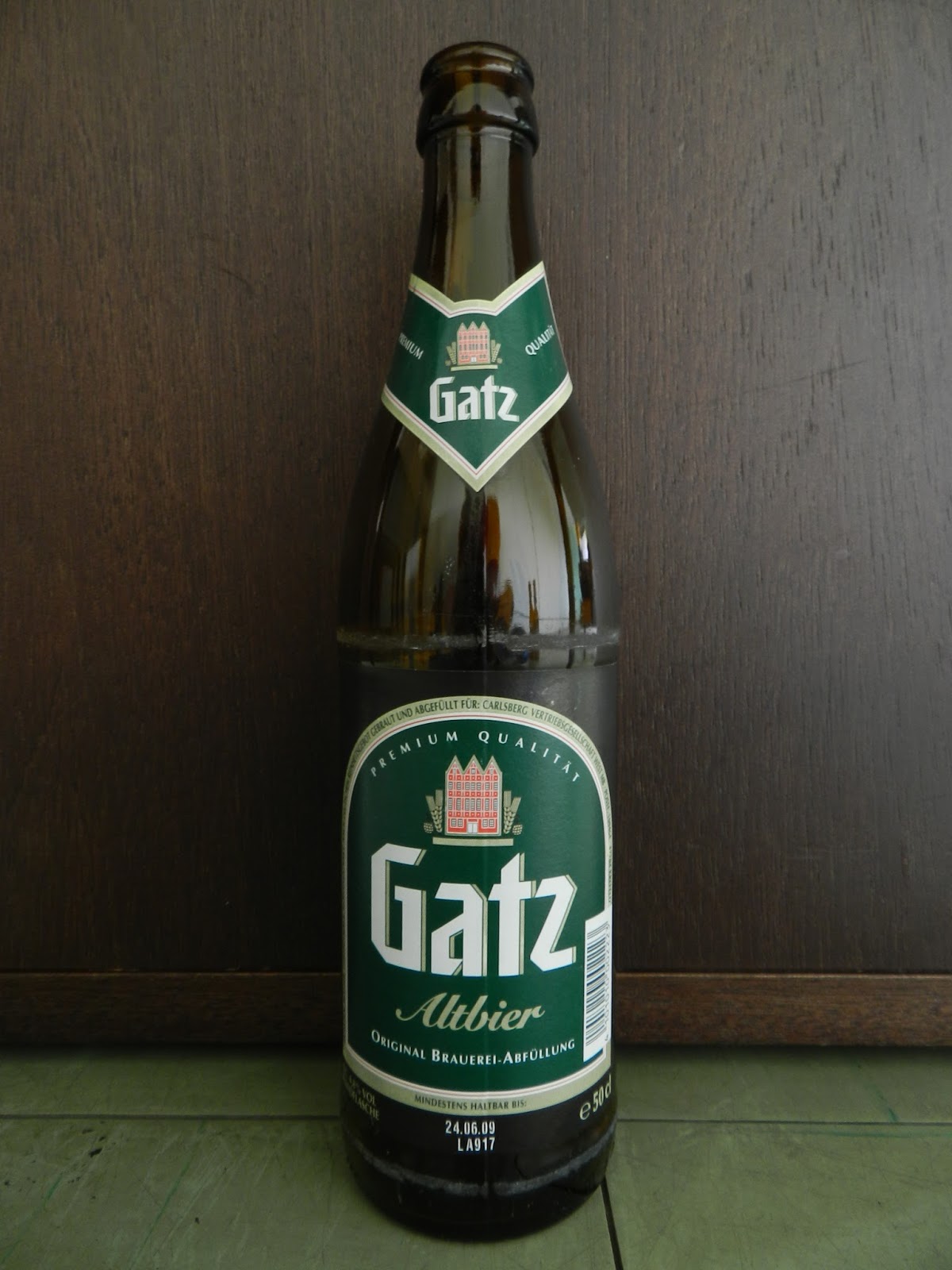
Gatz Alt - A short introduction to Altbiers

Fellow beer enthusiasts,

today I will go a little bit into the world of altbiers. I will do that by posting a very common altbier - Gatz Alt. With this, I intend to open a series of posts related to other Altbiers and to the city of Düsseldorf.

The Gatz Altbier is, since 1999, a part of the Carlsberg Brewery, it contains 4,8% alcohol and is sold mostly in 500ml bottles, such as the one I acquired in 2008 when backpacking through the region of North-Rhein Westphalia.

Gatz Alt - a part of the Carlsberg Empire in Düsseldorf

This region contains two rival cities, Cologne and Düsseldorf, each one with their very own kind of beer: Altbier for Düsseldorf and Kölsch for Cologne. Both use top fermentation yeasts (ales) and are fermented in warm temperatures (but still not as warm as the british ales). But the similarities stop there, the color and taste of the beers are completely different, making for two beer styles that are usually loved in their home town and despised at the other. Order a Kölsch in Düsseldorf, and you'll be sent straight to Cologne...

As much as I like the city of Cologne and do enjoy an occasional Kölsch, I have to say that I prefer the stronger taste of the Altbier.

Altbiers are dark in color and bitter in taste, and although they are produced mostly in Düsseldorf, there are brands of Altbier produced also in other cities, like Münster, Krefeld, Warstein and even in Cologne!! (More on that one later...)

This kind of beer is a surviving tradition... back in the time of the German unification, Bavaria imposed their purity law (Rheinheitsgebot) as a condition to join the forming country, which put an end to many spiced beers produced in the other regions. The Altbier survived this imposition, being nowadays one of the few traditional beer types with its origins in the northern portion of Germany.

When observing a map of the German breweries, one can notice the huge concentration of breweries in the southern portion (Bavaria and Baden-Württemberg) when compared to the northern states.

Beer map of Germany - Augmented area corresponds to Franconia (no surprise there)

That's it for this week my friends, in the next weeks I will be bringing some curious stories around Düsseldorf and some lower-scale produced Altbiers.

Cheers!

Aug 13, 2015

Homestead Lager


Dear fellow beer enthusiasts,

we all had already one of those days... those days when all turns out wrong, nothing goes your way and by the end of it, all you want to do is sit back on your favorite chair, relax and indulge in a beer.

Don't get me wrong, beer is for enjoying and not blanking out, and I don't believe any problems will ever be solved in the bottom of a bottle. As someone who truly enjoys the taste of beer and savours the moment and ambient created around it, I am aversed to binge-drinking and drinking for the pure sake of getting drunk is definitely not on my to-do list. I actually believe it is quite a waste.

Nevertheless, one glass, in good company, at the end of a stressful day can help you relax and improve your mood...

That is what I was going for after a particularly bad day in the beginning of 2007... it was a not-so-nice Sunday, definitely one of THOSE days I described in the first paragraph of this post, I went with a few friends to the stadium to watch the semi-finals of the regional football (soccer) championship.

I should've stayed home... the weather took a turn to the worst, the rain washed us completely and we were standing there, cold and miserable for almost 2 hours in a very empty stadium... meanwhile we were watching our team being beaten senselessly by 4x1. We were wet, cold and had no reason whatsoever to celebrate, our team had been eliminated from the championship.

After that, we decided that the best we could do was to just relax a bit and have a beer. We headed home and in my fridge there were only 3 bottles. They all were a gift from Mario Pedroni, a friend from university who worked on a ski station in the US during winter, and brought me the local beverages produced by the hotel at which he had worked.

The options were a Lager, an Ale and another one simply labeled "Beer". Being a good host, I let my guest, Henrique Strobl, choose first... he chose the Lager which names this post. A very simple lager, with undisclosed alcohol content, served in a 330ml brown bottle.

Homestead Lager: 1 out of 3 is not a proportion you want in a bad day

I chose the Ale, but once I poured the said "Ale" into the glass, I noted that something was very weird... there was no foam forming, and little gas bubbles were all over the glass... I took a sip, and it tasted like lemonade...

What I had in my hands, ladies and gentlemen, was a Ginger Ale... for those of you who, like me at that time, don't know what a ginger ale is, it is soda. Soda which for some reason carries the misleading word "Ale" in its name.

I was disappointed, as good as it could taste, it didn't fit the expectations for that rainy and cold afternoon. So I finished it quickly and went with high hopes for the third bottle, that one labeled "Beer".

As I poured it into the glass, the sensation of Dejà-vu filled me... again no foam, again the taste of soda and again the surprise provided by a very misleading product name... this time I was tasting a Root Beer.

While for me this was something completely new (I had never been to the US or heard of those sodas), it was not unkown to Strobl... he knew it all along and couldn't stop laughing at each one of my surprises.

That dayt I learned a very important lesson on international sodas and we ended up sharing the lager...

Now I can remember this story and laugh about it, but up to this day I wonder if Mário's intentions were honest or if he intended to play a prank on me...

Nevertheless, I thank him for the beer and for the story  :)

Cheers

Aug 5, 2015

Antarctica Original - The Old Companion

Dear friends and readers,

from all the beers I've tried in my life, this one is most likely the one I've consumed the most.

You see, some beers have a fine selection of malts and hops; some beers have exotic ingredients in their recipe; others rely on showing semi-naked women in their TV advertisements; and some print creative and colourful labels or use oddly shaped/coloured bottles to call the consumers attention.

Not this one.

This beer doesn't feature in expensive commercials (Antarctica barely advertises "Original"), it doesn't have anything exotic or special in its formulation and had held the same traditional old-fashioned lable for ages! Also the brown, 600ml bottle is the most regular bottle one can find in Brazil.

                                                 
Antarctica Original - Good ol' college companion


Its taste is, in my opinion, only slightly better than the other InBev-produced Brazilian beers (like Skol, Brahma, etc...) and it is not (much) more expensive than the other brands either... but this beer STILL holds a special place in my collection and in my memories...

I mentioned in my last post that the taste of a beer has a strong relation with the occasion in which you consume the beer, and that's what makes this beer so special to me. It is enough to say that this is the beer that was sold at the students center, Centro Moraes Rego (or simply CMR), during my university years.

I usually try to tell a story for each beer that I post here, but this one has simply too many stories... a good one is maybe how it was used by the CMR's administration as leverage on a negotiation with the veteran students: It would be sold at cost-price as long as there was no smoking indoors in the common area - a rather weird deal, but good for all parts involved :)

Many strong friendships were built while sipping from these bottles, many good parties were fueled by it and many calm and enjoyable evenings went by while playing pool, cards and/or just talking and clinging bottles at CMR

Living away from my home country, sometimes I feel nostalgic, and when I do, not even the finest IPA will help.

Too many "beer connouisseurs" get too full of themselves and snobish from the top of their refined ales and craft beers and end up forgetting that, in the end, the most important thing is not what you are drinking.

But with whom you are drinking...

Cheers.

Jul 30, 2015

Dark Island Reserve - The 1000th Beer Bottle


The year was 2000 when I first tried a beer which was not a regular Brazilian Pilsner... and by the beginning of 2001 I had a few bottles decorating my shelf. In 2008, with some 250 bottles in my collection, I set a goal... I wanted to try and collect one thousand different beers before I die.

At the time, it sounded like a reasonable goal... not impossible to achieve, but still hard enough to keep it interesting. In 2009 I moved to Germany, and realized that my goal might had actually been set too low... in 2012 I had 800 bottles and in June, 2014, it finally happened...

It was not like other milestones like the 700th, 800th or 900th bottle, which passed unnoticed... no, the 1000th bottle required some preparation, and it was a hard choice to decide which beer would fill in that symbolic but most important post.

In April 2014 I came across this quite uncommon 750ml bottle in a specialized shop in Caen, France. The label itself called my attention at first, and when I read the specifications of this 10% orcadian ale, I realized I had in my hands a strong candidate for such a special occasion.


It is brewed by the Orkney Brewery in small batches and aged in oak casks which were formerly used for the production of fine malt whiskeys. It is a very exclusive beer and the price paid for it reflects this fact very well...

I am a firm believer that the taste of a beer is much more related to the occasion in which you drink it than to its price... the cheapest, most watered down pilsen in the world can taste amazing if drank in a hot summer afternoon in the company of good ol' friends, and the fanciest sparkling ale can prove to be a quite boring experience if the occasion just doesn't fit...

But when you combine a great beer with a great moment, you can generate a once-in-a-lifetime experience...

The occasion was very well planned, I had friends from different places visiting, the celebration party went from the early afternoon well into the next day's morning and in that meantime we opened the 998th, the 999th and finally, the Dark Island Reserve.

The choice I made for my 1000th beer bottle proved to be a wise one... this is a beer for great moments, and I say that having tried only a small volume of it, after all, sharing it with good ol' friends was part of the experience.

I still haven't defined a number for my new "life goal", but I definitely want to find and drink this beer again. I am just afraid it will never taste as good as it did on that rainy but amazing late June afternoon....

Maybe when I reach 2000... :-)

Cheers!

Jul 23, 2015

Faust brewery - Auswandererbier


Dear readers and beer enthusiasts,

as I told you, during the 3 years gap in this blog, my collection went over 1000 beers... This event didn't go without notice! It was celebrated in June 2014, among friends from several different nationalities, several of them, immigrants.

With the exeption of a Brazilian who came from London, all of them have immigrated to Germany... we had an Italian and an Ucranian coming from Munich, a Mexican coming from Berlin, a Turkish who lives in Frankfurt, a Croatian who built her life in Karlsruhe, a Chinese who now holds German nationality and, finally, me, a Brazilian host who had been in Germany for almost 5 years at that point.

But why the hell I am telling you about this whole mess of immigrants gathered in a house, drinking beer and celebrating? Isn't this the story of the 1000th beer bottle?

No, it isn't.

My German-speaking readers might have already realized where I am going with this... the name of this beer - Auswandererbier - translates to "The emigrant beer" and the numbers printed below it - 1849 - represent a very specific year in Germany.


1849 was a hard year in Baden

It is the year when a Democratic revolution was supressed by the Prussian Monarchy, in events that later led to the creation of Germany in 1871.

Due to the monarchy persecution, in between the years of 1850 and 1891, around 4 million Germans emigrated to the USA, in between those emigrants, was August Krug, whose father owned the brewery "Zum Weissen Löwen", today known as Faust brewery.

His father, Anton Georg Krug, created this high alcoholic beer for his son, adding extra hops so it would last the ship trip to America. Later on that year, Anton sold the brewery and followed his son to the USA.

Nowadays, Faust brewery pays tribute to its previous owner and his son through this 8,0% alcohol ale, made with both American and German hops.

Auswandererbeer - Emigrant beer

Today, less than one and a half centuries after the revolution and the german emigrating movement, Germany is one of the preferred destination of emigrants and the 3rd country in number of foreign students. It is not weird if it was then drank by a multinational bunch, in a celebration in Karlsruhe, less than 40km away from where one of the last revolutionary fortresses (Rastatt) fell in 1849...

I have quite some simpaty towards this ale, once I am myself an emigrant (one that happens to love extra hoppy beers!) and I can just imagine how hard a German emigrant would miss good beer in the USA at those times...

Just as a follow up, this was the 999th bottle of my collection, the story of the 1000th comes next week...

Cheers!!!

Jul 16, 2015

Rothaus Tannen Zäpfle - Crossing the Atlantic

It is common for governments to own businesses.

There are state owned power plants, state owned oil companies, telecommunications and so on.

But in Germany (oh, Germany...) there are state owned BREWERIES! A very good example of such wonder is the Tannen Zäpfle Rothaus Pils, product of the Badische Staatsbrauerei Rothaus AG

Tannen Zäpfle - "Karlsruher gold"

Owned by the state of Baden-Württemberg, this beer is very easy to find in the city where I currently live, Karlsruhe. The metallic golden wrap which covers the neck and cap of this bottle can (sadly enough) be found spread around apartments, squares, train stations, universities or whatever place which has hosted a party or a "small social gathering" the day before.

That gave this beer the local nickname of "Karlsruhe's gold"... and by the price that a few clubs charge you for a 330 ml Rothaus bottle, the idea that there is some gold in it starts sounding actually quite reasonable...

It is a German pils, light and easy to drink, slightly more alcoholic than a regular pils (5.1%) and usually served in 330ml bottles as the one above

But although I've lived in Karlsruhe for some time already, this bottle was acquired years before, in Munich. At that time, I was not really sure about staying in Germany, and had to go back to Brazil to solve a few issues before making my decision.

So this bottle, together with approximately another 200 I had gathered in my two years of Munich, crossed the ocean to Brazil. It was not a smooth ride, the careless treatment from part of the mail companies and a strike of the Brazilian post offices contributed for the loss of around 20 of the bottles.

Moving continents is never easy... but I did it again in 2012, and came back to Germany. The bottles didn't come with me right away, my sister gently kept them at her place for a few years.
When it came the time to bring them, in January of 2015, I opted for a moving company to do the transport. This time, it was over 800 bottles being shipped to my new home in Karlsruhe.

The transport took months and I got to admit that, having the loss rate of 10% from the last time still in mind, I was scared about losing rare bottles in the process. When the packages finally arrived, I immediately started checking for broken bottles. After going over hundreds of bottles, I found a single broken one.

800 bottles, and only one was broken... not a bad number one would say, but if that was a rare bottle, the loss would still haunt me. I unwrapped it carefully, trying hard not to cut myself, and facing the dreadful possibility of losing yet another rare bottle...

But this is what I found inside the bubble wrap: 

A tragic loss... or maybe not

I didn't even remember that this bottle was in the moving, but I was so relieved to see the golden metallic sheet and the green lable emergin from the protective plastic...

Did I say relieved? No, no ,no... I meant DEVASTATED! So utterly devastated I walked 15 meters to the next bar and washed my sorrow away... with a Tannen Zäpfle  :-)


Cheers!